

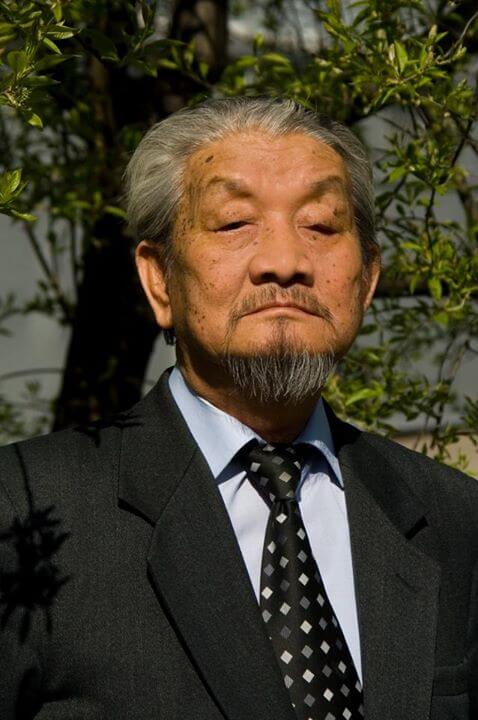
Anatoly Tsoi
(1939 – 2022)
“We are all children of the Sun! Our souls emerge within solar prominences and perhaps even further, to the stars—to gather knowledge. Having gained wisdom through experience, we return to the Sun, which bestows immortality, light, and warmth upon all living things.”
The Book of Tangun” from the trilogy “Under the Constellation of the Great Bear
Nuclear physicist, Candidate of Physical and Mathematical Sciences, Associate Professor. Born on April 17, 1939, in the village of Soldatskoye, Tashkent Region.
Married, with two children and a grandson.
After graduating from Tashkent State University in 1963, he worked at the Institute of Nuclear Physics of the Academy of Sciences of Uzbekistan under the direct supervision of Academician S.V. Starodubtsev, a close associate of A.P. Alexandrov, President of the USSR Academy of Sciences, in the field of nuclear reactors.
After defending his Candidate of Sciences dissertation in 1969, he served as the head of a laboratory at all-Union and republican academic institutes in Tashkent, Frunze, Alma-Ata, and Moscow. Throughout his career, he addressed issues concerning the effects of radiation on organic and inorganic substances, the development of automated process control systems for forecasting and regulating mountain river runoff, mudflow protection, and the automation of scientific research.
He developed the theory of technological processes, created several application software packages, published over 100 scientific articles and three monographs, and holds five patents.
Between 1992 and 1995, while serving as president of the Baikonur Joint-Stock Company in the city of Leninsk, he participated in negotiations in China and Korea, became interested in the history and mythology of these nations, and began collecting materials.
As a result of his research, in 2010 he published the novel Under the Constellation of the Great Bear (Book 1: Kosil; Book 2: Tangun), followed in 2012 by a fairy tale for both children and adults titled Goddess Tanya.
Alongside his literary activities, he continued developing a new oil-processing technology. This technology will be in particularly high demand in the near future, once Russia’s reserves of light crude oil have been exhausted.
In 2013, the Ministry of Education and Science of the Russian Federation provided financial support for a project to develop a technical system for radiation-wave cracking, spanning the period up to 2015.
Member of the Russian Writers’ Union.